Thursday, June 19, 2014

Cosmos: Mostly Wrong

Andrew O'Hehir:

One mistake Druyan never makes, either in “Cosmos” or anywhere else, is the arrogant historicism sometimes displayed by Richard Dawkins and other prominent scientific atheists. By that I mean the quasi-religious assumption that we stand at a uniquely privileged position of near-perfect scientific knowledge, with just a few blanks to fill in before we understand everything about the universe. “I’m sure most of what we all hold dearest and cherish most, believing at this very moment,” Druyan has said, “will be revealed at some future time to be merely a product of our age and our history and our understanding of reality.” Science as a process, as “the never-ending search for truth,” is sacred. But what we now know, or think we know, is always a matter for humility and doubt.

I have a very clear memory of arguing with my parents about a sixth grade oral report on quasars based mostly on my copy of Cosmos. I wanted to say, for example, "Quasars are 4 to 6 billion years old," and that was not acceptable. I had to say "scientists currently believe..." At the time that seemed quite tedious and pedantic. Of course Carl Sagan had to be right!

Wednesday, June 18, 2014

A Straightforward Vision for Public Colleges and Universities

David Dayen:

First of all, wrangling over student loans and interest rates and refinancing obscures the long-term vision - public colleges and universities should be free to attend. Or at least as close to free as possible. Though it may take time for the majority of the public to realize it, this idea is not far-fetched. The United States currently spends enough on grant aid, tax preferences and loan subsidies to cover the cost of tuition at every public college and university.

Tuition is not the only expense, and more funding would be needed to make college free or near-free. But using existing resources - and moreover, returning them to pre-recession levels - gets us a lot of the way there. Think of it as a two-track alternative: first, a “public option,” subsidized by states and the federal government, available to students attending public institutions. If a student wants to attend a private college instead, that’s fine, but they shouldn’t benefit from public subsidies to do so. Ultimately, competition from a free college option will probably bring down the cost of private higher ed, which can be accomplished by removing the vast administrative bloat, outrageous executive compensation and unnecessary spending that characterizes far too many of these institutions.

Friday, June 13, 2014

The Meta-Reform That Would Enable All Others

Rachel Evans:

This is a not-so-complicated question. Effective teaching requires collaboration with colleagues, and in the U.S., this time is too limited. In Singapore and Shanghai, teachers work 40 hours a week—but they spend just 10 to 18 of those hours teaching. They use the remaining time to collaborate with colleagues and improve their practice. Compare that with the U.S., where educators teach 25 to 32 hours per week.

Less in class time for all teachers.

Thursday, June 12, 2014

This is the Sort of Thing which Slows Down the Morning Commute to Play Group


I Leave Comments

Me:

One thing to keep in mind is that many reform critics, including myself, have worked with Gates and other big foundations in the past, and one way or another been burned by the experience. In my case, Gates gave my colleagues and I a lot of money to create a small neighborhood high school in Providence, and then after Gates decided they weren't interested in small schools, we were hung out to try and closed, even as our test scores shot up and we had the highest college enrollment and retention of any neighborhood high school in the city.

Now, you can't blame Gates directly for our school being closed, but I think it is emblematic of their particular problem. That is, how can a massive private foundation -- but still small in budget compared to overall government spending -- improve education across the country in a measurable way in a short time frame? I think the short answer is turning out to be that it is impossible or extremely difficult, but in the meantime, they're going to thrash around from one increasingly disruptive option to the next, in increasing frustration, leaving a trail of orphaned initiatives in their wake.

In this respect, Gates is different than a lot of the more ideological foundations. Gates has a definite point of view, but they aren't like Broad or Walton or many of the others, which essentially have always wanted to disassemble public education. Gates has just drifted that way over time out of frustration, and it is hard to see what will stop that process.

Wednesday, June 11, 2014

If You Read Charlie Stross's Post, You'll Know More About the Scottish Independence Situation Than I Did After Living Here 10 Months

Charlie Stross:

We have an SNP government. They promised, and got, a referendum that, this September 18th, will ask people like me (anyone who lives here, basically) to vote on the question "should Scotland be an independent nation?" It's a straight yes/no question. The third option, Devo Max, was ruled off the ballot by David Cameron (probably because he knew it would win by a mile—over 60% of the Scottish voting public supported it as of the last poll I saw that asked about it). Devo Max was a last mile marker for a devolved parliament short of full independence: Scotland would acquire control over all internal affairs, including taxation, but would delegate defence and foreign affairs to Westminster. It's my preferred option. Such a shame we're not allowed to vote for it ...

Anyway. A vote will be held on the 18th of September. If there is a majority for independence, then the constitutional shit will hit the fan because Westminster will be required to negotiate and enact the enabling legislation for Scottish independence ... with a UK-wide General Election coming up in June 2015. The enabling legislation can't be rushed through before the next election (it's too big and complex), so it's going to trail into the next Westminster parliament, probably completing in 2016 with independence in 2017. But the next Westminster parliament cannot be bound by the decisions of the current one—basics of the British constitutional system here—and so can't automatically be held to handle the consequences of the independence vote. It's anybody's guess what the government in Westminster will look like in July 2015. It might be a renewed Conservative/Lib-Dem coalition (unlikely), a Conservative majority or minority government (less unlikely), a Labour majority (not unlikely), a Labour/Lib-Dem coalition (possibly most likely, but still not something to bet on), a Conservative/UKIP coalition (unlikely but not impossible), or a Martian invasion. Nobody knows. Add to this, 70 Scottish MPs elected on a mandate to sit for 12-18 months while they negotiate independence, then pack their bags and go home. It'll be chaos.

Understanding Tim Shanahan

Tim Shanahan:

I'm just as amazed about the cartoon figures on the left as well. You know the ones I mean (the ones who are arguing that unemployment is a problem, but the 1 million unfilled jobs in America is not). They want equality for all sexual persuasions, races, ethnicities, languages, and legal statuses--until someone tries to do anything to shrink the educational differences among those groups. According to these geniuses, if you set high educational standards, you are doing it to emphasize existing differences.

Regarding Lyndsey Layton's Piece on Gates and the Common Core

Let's start with the video, since I just made myself sit though a half hour of Bill Gates talking, and nothing makes me feel like my life is slipping away more than listening to someone talk on the internet.

First off, billg is annoyed, and we can all be happy about that. Personal annoyance is one of the few checks the public has on the behavior of billionaire philanthropists. How long can anyone sit around thinking about how he just spent $200 million dollars to make half the country think that he is the greedy, meddling asshole that is personally responsible for making their children hate 2nd grade?

Gates wants to talk about "substance," not "politics," which is difficult given that he has chosen to step into perhaps the most deeply political facet of education -- what children should be taught and learn, and why. But I do wish Layton could then pivot and ask even some simple questions about the "substance" of the standards.

Gates repeatedly praises Massachusetts' standards. Why not ask why they are not the basis of the Common Core standards. He talks about R&D; and listening to teachers -- why did they not build the process around the experiences of master teachers in Massachusetts to refine what were already the consensus "best" standards in the country? And you know what, that's not even a fake gotcha question -- I really want to know!

Ultimately, Gates' view seems to still lean heavily on the premise that nothing serious was done in education before he showed up. As if before the Common Core, we just had 50 sets of slapdash, random state standards. No NCEE, no American Diploma Project, no NCTM, no NCTE/IRA, nobody thinking about connections between high school and college. He seems to really believe that the Common Core is "the most serious effort" yet to create well researched standards. Given how quickly the Common Core was slapped together, by such a small, inexperienced, homogenous team (especially the all-important initial design), I just don't see how anyone can believe that.

Switching to Layton's article, that point is only reinforced.

Layton begins:

The pair of education advocates had a big idea, a new approach to transform every public-school classroom in America. By early 2008, many of the nation’s top politicians and education leaders had lined up in support.

But that wasn’t enough. The duo needed money — tens of millions of dollars, at least — and they needed a champion who could overcome the politics that had thwarted every previous attempt to institute national standards.

So they turned to the richest man in the world.

On a summer day in 2008, Gene Wilhoit, director of a national group of state school chiefs, and David Coleman, an emerging evangelist for the standards movement, spent hours in Bill Gates’s sleek headquarters near Seattle, trying to persuade him and his wife, Melinda, to turn their idea into reality.

Coleman and Wilhoit told the Gateses that academic standards varied so wildly between states that high school diplomas had lost all meaning, that as many as 40 percent of college freshmen needed remedial classes and that U.S. students were falling behind their foreign competitors.

Let's backtrack a minute. Coleman you should know by this point, but who is Wilhoit?

In 2008, he was head of the Council of Chief State School Officers (CCSSO). Prior to that, he had been Commissioner of Education in Kentucky from 2000 to 2006. He apparently also had that job in Arkansas at some point. The point is, Wilhoit had ample opportunity to influence the status quo in American standards writing in the years leading up to 2008. As commissioner in Kentucky, he had brought the state into the American Diploma Project as one of the five original partner states. Wilhoit and Gates both knew that all the research had already been done, the standards written, gap analyses run against various state standards, new versions of state standards developed to align more closely to ADP, including by Kentucky, real statewide changes had happened that could be observed in 2008 based on quantitative and qualitative data and feedback.

Then, apparently, in 2008, Wilhoit, Gates, and basically every single person other than Sandra Stotsky, James Milgram and me either forgot, pretended to forget, or never knew that the ADP ever existed and moved on into the Common Core era as if it was a bold new idea. I still just don't get this. Did Coleman somehow personally convince everyone that he could do better than ADP? Did he lay out some kind of flaw? Not compatible enough with computer-based curriculum and assessment?

That's what I'd like to understand someday.

Wednesday, June 04, 2014

This is Incredibly Unpersuasive

Steve Rappaport:

Rahm Emanuel famously said, “Never let a good crisis go to waste.” We must find ways of making this a teachable moment, seize it as an opportunity to educate stakeholders in the education community about both the myriad ways in which data are central to the mission of public education, and how we can work together to ensure--as best we can--that data can be used in the service of teaching and learning without sacrificing privacy or the security. I believe that the overwhelming majority of educators, parents, and other stakeholders would welcome that message, and that by articulating the centrality of data in administrative and academic operations, it might contribute to a much-needed change in the dynamics of the debate over the role of data in public education.

If data plays a central role in schooling, it should be controlled by the school community and district, not farmed out to vendors. If schools don't have the technical capacity to manage systems themselves, we need to invest in school and district level capacity building so they can.

Garbage In; Transparent Garbage Out

Bill Fitzgerald:

If you are building or working with a data system, it needs to have these two components:

  • Student dashboard - a student should be able to see everything that is collected about them. More importantly, the application should have a mechanism that allows students to comment on, review - and in some cases, remove - data points, or assumptions based on data. More on this later.
  • Parent dashboard - because many students are minors, parents have the legal right to review data collected. Additionally, rights to review some data is guaranteed under FERPA. Really, there shouldn't need to be much - if any - difference between the student and parent dashboard. If there are significant differences between a parent and student view, those differences should be grounded in clearly articulated reasons that are of direct benefit to the learner.

We can't lean on this approach too much, particularly if you're talking about big data online learning platforms. There is too much raw behavioral data, they can't practically let you check your answers without making all the questions and answers public, and their conclusions based on the data, particularly ones just used in their internal model, may just be garbage anyhow. If your online learning platform concludes you're a spatial, abstract sequential learner with a 43.2 grit quotient, who likes Dark Tearjerkers Featuring a Strong Female Lead and a high level of distortion on the electric guitar then... ?

Tuesday, June 03, 2014

Raising School Funding by 20% Results in a $20 Million Increase in Lifetime Earnings Per Classroom

Chetty, Friedman and Rockoff:

At age 28, the old-est age at which we currently have a sufficiently large sample size to estimate earnings impacts, a 1 SD increase in teacher quality in a single grade raises annual earnings by 1.3%. If the impact on earnings remains constant at 1.3% over the lifecycle, students would gain approximately $39,000 on average in cumulative lifetime income from a 1 SD improvement in teacher VA in a single grade.

Multiply that times 30 and you get $1,170,000 for a whole class. Wow! ONE MILLION DOLLARS.

Holly Yettick:

For low-income students who spent all 12 years of school in districts that increased spending by 20 percent, graduation rates rose by 23 percentage points. Due to the measurement error or “noise” found in almost any study of this type, the effect could, very plausibly, be as low as 8.7 percentage points and as high as 37 percentage points. The estimates are based on the study’s analysis of 15,000 children born between 1955 and 1985. All account for a host of other potential explanations, such as school desegregation, War on Poverty programs, and demographic changes. ...

Between the ages of 25 and 45, these same children were 20 percentage points less likely to fall into poverty during any given year. (Estimates vary from 8 percentage points to 31 percentage points.) Their individual wages were 25 percent higher than they would have been without the changes, with estimates ranging from 3 percent to 45 percent, according to the paper. And their family incomes were 52 percent higher, with estimates ranging from 17 percent to 86 percent.

OK, let me get out the back of an envelope... 25/1.3... $22,500,000 per class/lifetime.

Yeah, that's probably baloney, but is it more or less so than the rest of this stuff?

The Chetty Mechanism

If we're back to discussing Chetty, Friedman and Rockoff again, I'll get something off my chest. I've not seen much discussion of how higher test scores translate to better long term outcomes. What's the model exactly, and in particular, how does this work per subject area?

From the perspective of ELA, and reading tests in particular, this is pretty mysterious. I mean, learning more is good! More vocabulary, better reading skills, insofar as they exist, are good, but it is hard to break it down beyond the most general handwaving.

In math, it is much more plausible and straightforward, because math is used as a gatekeeper course and presented as a linear progression. If one good teacher can bump a handful of kids up a level in math -- particularly if the school is tracked by math, as would have been common in the timeframe for Chetty's study -- that will change their opportunities, peer group, etc. in a fairly straightforward way. If you bump up a group in math, you don't need to maintain a higher rate of learning indefinitely, just one accelerated year and then you can continue at the same pace as your peers.

Or, one bad year has similar knock on effects.

Also, whether or not your math curriculum or assessment is "authentic," a standardized math test is going to be a fairly valid predictor of how you're going to do on other math tests, at least compared to, say, a reading test's assessment of how you do on all types of reading and ELA assessments in class.

I'm not going to dig back into it now, but I think at the time I looked for separate data for math and reading and did not find it.

On a personal level, it is not hard for me to believe that if I'd had a single "top 5%" math teacher in high school, I might not be making 1% more a year, I might be making two or three times what I make now. Over a lifetime, that'd be like two or three million, which would more than cover Chetty's predictions for a whole class. It is a lot harder to imagine a great English teacher would have made me rich.

Economists are math people, so they tend to think that math education is the standard paradigm for education in general. It isn't. It is the outlier. If you build your model of education around the subject of mathematics, you have no chance of getting it right.

Monday, June 02, 2014

Growing Up Absurd-er

David Graeber:

Well, here we go back to the question of unpaid internships again. Some years ago I wrote a piece for Harpers called “Army of Altruists” where I tried to grapple with the power of right-wing populism, especially with the way that “we hate the liberal elite” and “support the troops” seemed to have a very similar, deep resonance, even to be a way of saying the same thing. What I ended up concluding is that working class people hate the cultural elite more than they do the economic elite—and mind you, they don’t like the economic elite very much. But they hate the cultural elite because they see them as a group of people who have grabbed all the jobs where one gets paid to do good in the world. If you want a career pursuing any form of value other than monetary value—if you want to work in journalism, and pursue truth, or in the arts, and pursue beauty, or in some charity or international NGO or the UN, and pursue social justice—well, even assuming you can acquire the requisite degrees, for the first few years they won’t even pay you. So you’re supposed to live in New York or some other expensive city on no money for a few years after graduation. Who else can do that except children of the elite? So if you’re a fork-lift operator or even a florist, you know your kid is unlikely to ever become a CEO, but you also know there’s no way in a million years they’ll ever become drama critic for the New Yorker or an international human rights lawyer. The only way they could get paid a decent salary to do something noble, something that’s not just for the money, is to join the army. So saying “support the troops” is a way of saying “fuck you” to the cultural elite who think you’re a bunch of knuckle-dragging cavemen, but who also make sure your kid would never be able to join their club of rich do-gooders even if he or she was twice as smart as any of them.

So the right wing manipulates the resentment of the bulk of the working class from being able to dedicate their lives to anything purely noble or altruistic. But at the same time—and here’s the real evil genius of right-wing populism—they also manipulate the resentment of that portion of the middle classes trapped in bullshit jobs against the bulk of the working classes, who at least get to do productive work of obvious social benefit. Think about all the popular uproar about school teachers. There’s this endless campaign of vilification against teachers, who they say are overpaid, coddled, and are blamed for everything wrong with our education system. In fact, grade school teachers undergo really grueling conditions for much less money than they’d be paid if they’d gone into almost any other profession requiring the same level of education, and almost all the problems the right-wingers are referring to aren’t created by the teachers or teachers’ unions at all but by school administrators—the ones who are paid much more, and mostly have classic bullshit jobs that seem to multiply endlessly even as the teachers themselves are squeezed and downsized. So why does no one complain about those guys? Actually I saw something telling written by a right-wing activist on some blog—he said, well the funny thing is, when we first started our school reform campaigns, we tried to focus on the administrators. But it didn’t take. Then we shifted to the teachers and suddenly the whole thing exploded. It’s hard to explain that in any other way than to say: a lot of people resent the teachers for having genuine, meaningful jobs. You get to shape young lives. You get to make a real difference for other people. And the logic seems to be: shouldn’t that be enough for them? They want that, and middle-class salaries, and job security, and vacations, and benefits, too? You even see that with auto workers. “But you get to make cars! That’s a real job! And you also want $30 an hour?”

It’s an imperfect strategy. The anti-intellectualism for instance works on many sections of the white working class, but it doesn’t work nearly so well on immigrants or African-Americans. The resentment against those who get to do meaningful labor exists alongside a resentment for having to do meaningless labor to begin with. It’s an unstable mix. But we have to recognize that in countries like the US, it’s been pretty effective.

Sunday, June 01, 2014

Things I Don't Understand at All

Anya Kamenetz:

The lawsuit names students including Briana Lamb as members of the class. In the fall of 2012, when Lamb showed up for her junior year at Fremont High School in South Central Los Angeles, she says her schedule was full of holes. "I had four 'home' periods, and one 'service,' " she said. A home period means just that: the student must go home. During a service period, sometimes you help teachers do photocopying or pass out papers. Lamb says that at other times it just means sitting around. That meant Lamb had actual classes for just a few hours a day—not enough to graduate on time. "It made me nervous," she said. "I knew exactly what classes I needed to be in to finish my 11th grade requirements." But it took weeks to sort them out.

This is John Deasy's LAUSD?

Jenna Harrison:

Moreover, majority of the seminars led by TFA staffers were more detrimental than helpful to my development as a first-year teacher. While I appreciated the sentiment behind the sessions on culturally responsive teaching, many a time they continued to contribute to the racist mentality I believed that TFA was perpetuating through its recruits. Majority of these sessions consisted of a person of color preaching to a room full of Corps Members that white people are the reason why our students suffer. As an individual who is very well-versed in white privilege, I believe it is downright ignorant to blame an entire country’s shortcomings in educational equity simply on race. Instead of wasting precious instructional time on essentially brainwashing its Corps Members, Teach for America should focus its efforts instead on recruiting CMs that are well-versed in ALL of the injustices individuals face in our global society - regardless of their sex, ethnicity, sexual orientation, gender identity, religious background, etc.

That just sounds like the worst case scenario all around, and pretty much the kind of time-wasting psycho-babble we've been told practical alternative certifications are needed to avoid. But, who knows?

Thursday, May 29, 2014

If You Read Only One Thing This Month or Next...

Read Maciej Cegłowski's talk, The Internet with a Human Face:

Of course, for ad sellers, the crappiness of targeted ads is a feature! It means there's vast room for improvement. So many stories to tell the investors.

This ghost of a business model propels us to ever greater extremes of surveillance. If the algorithms don't work, that's a sign we need more data. If the algorithms do work, then imagine how much better they'll work with more data. There's only one outcome allowed: collect more data.

Maybe if we start calling cities a "disruptive innovation?"

Jon Geeting:

When the city was shrinking in population, city politicians were consumed with how to bribe companies to locate their headquarters here, or how to make suburban people like us and come and visit the city, using subsidized Big Culture institutions, hotels, and underpriced, oversupplied parking. But now, even though the city has been growing, the politics haven't really changed.

We're still subsidizing hotels, oversupplying parking, and spending far too much time worrying about whether suburban people will come spend their money here, rather than focusing on providing the fundamental amenities our citizens want - good schools, safe neighborhoods, clean streets, low-cost transportation choices, and nice public spaces. Why do we keep wasting money on corporate tax breaks and short-sighted get rich quick schemes instead of focusing on the fundamentals?

Wednesday, May 28, 2014

What is the Relationship Between Humanities and Literacy?

Valerie Strauss:

The Boston public schools district found itself in the position of having to issue a public statement denying that it was eliminating its history and social studies department after someone posted on the Web that it was and the news went viral in the education world. Historians assumed it was true and rightly flipped out.

What happened?

According to Eileen de los Reyes, deputy superintendent of academics, the school district is, for the first time in many years, reorganizing its academic departments to make them more inter-disciplinary and to help implement the Common Core State Standards. As part of the reorganization, job positions are being rewritten across the various departments and dozens of people are being asked to reapply for their jobs. People in the history department did get notices but they weren’t the only ones. Part of the online buzz was that history and social studies were being absorbed into a new uber-humanities department. In fact, the departments of history, English-Language Arts and world languages are coming under a new humanities umbrella for purposes of better coordination, she said. Likewise, a new science umbrella will include science, technology and engineering, while a new “specialized learning” umbrella will include special education and English Language Learners.

Ah yes, nothing helps a district with apparent problems with absorbing a stream of externally imposed reforms, inter-departmental rivalry, and communication than a between-superintendents reorganization hastily drawn up in response to a self-interested consultant report.

More specifically though, hacking together an interdisciplinary scheme in response to the Common Core ELA/Literacy standards is bound to go badly, because the CC does not manage to articulate a vision for English and/or Language Arts as a complete discipline.

There's definitely muddled language around this new "uber-humanities" umbrella. Is it "humanities" or "humanities and literacy," as suggested by the title of the new job description? It seems as though the "arts" will not be part of the "humanities" in this scheme, but its own cluster.

This is like creating a new cluster for math, science and technology called "STEM and Numeracy," while keeping computer science and robotics in its own separate domain.

School reform that is intellectually incoherent is just not going to work.

Monday, May 26, 2014

Off-Year, Low Turnout Elections: What Could Go Wrong?

David Atkins:

The only possible way that a party of social tolerance survives for long in this sort of economic environment is if it goes hard after the plutocrats truly responsible for the economic malaise. The social liberal/economic conservative mold of Bloomberg is a recipe for political disaster.

It is notable that the only places where the far right was brought to heel were places where a strong leftist economic argument was made. The big, big loser was cautious, austerity centrism.

When the social left throws the economic left under the bus in a time of rising inequality, they sow the seeds of their own destruction. The forces of intolerance and fascism are only a couple of hard-knocks elections away at any given time.

...it's the old The Situation Is More Nuanced Than You Liberal Naifs Believe It Is trick

tristero:

As Maxwell Smart might say, it's the old The Situation Is More Nuanced Than You Liberal Naifs Believe It Is trick.

Actually it's not. Without the moolah flowing from the Kochs or the loon whisperers at Fox News, there'd still be too much funding and exposure of rightwing extremists but there would be a lot less of it. And yes, I would be satisfied that things were flowing in a good direction if the Kochs and Fox were "beaten back."

One good thing about having Diane Ravitch on your side is that passes on her immunity to that trick.

It Doesn't Get Better When You Mix In Overconfident Educational Technocrats

Quinn Norton:

Once upon a time, a friend of mine accidentally took over thousands of computers. He had found a vulnerability in a piece of software and started playing with it. In the process, he figured out how to get total administration access over a network. He put it in a script, and ran it to see what would happen, then went to bed for about four hours. Next morning on the way to work he checked on it, and discovered he was now lord and master of about 50,000 computers. After nearly vomiting in fear he killed the whole thing and deleted all the files associated with it. In the end he said he threw the hard drive into a bonfire. I can’t tell you who he is because he doesn’t want to go to Federal prison, which is what could have happened if he’d told anyone that could do anything about the bug he’d found. Did that bug get fixed? Probably eventually, but not by my friend. This story isn’t extraordinary at all. Spend much time in the hacker and security scene, you’ll hear stories like this and worse.

It’s hard to explain to regular people how much technology barely works, how much the infrastructure of our lives is held together by the IT equivalent of baling wire.

Computers, and computing, are broken.

Friday, May 23, 2014

Meg Whitman is Doing Her Part to Solve the Shortage of STEM Workers... ARE YOU?

Rick Merritt:

SAN JOSE, Calif. — Hewlett-Packard will lay off another 16,000 workers on top of 34,000 layoffs it already announced. The move could save up to an additional billion dollars a year by 2016 on top of the maximum $4 billion savings previously anticipated.

Wednesday, May 21, 2014

At This Point, the Process Should Have Been Halted and Completely Re-thought

Cathy Kessel:

Summary

Education policy is complicated, and cross-national comparisons of education policy are even more complicated. This post is not meant to be a comprehensive account of either, but to make the following points:

  • In their official documents, not all countries communicate the kind of detailed expectations for student performance that U.S. readers are accustomed to seeing in standards documents.
  • Details of curriculum and expectations for student performance may occur in teacher’s guides, textbooks, and teacher’s manuals; and in findings of empirical research.

The two posts that follow comment on two comparisons of the CCSS with standards and course of study documents from other countries, adding relevant details from textbooks, teacher’s manuals, and other sources.

Another way of putting this is simply, high performing countries don't use standards, at least as we define them post-NCLB.

Tired of Non-Profits

While, no, the Common Core won't turn your children gay, the Florida tests will be written by a non-profit that supports LGBT Youth. Not that there is anything wrong with that, but it is a kind of weird juxtaposition. I'd rather see them drop test development than the LGBT work.

The broader question here though is, why is our massive testing industry "non-profit?"

The reason this somewhat farcical accusation about the Common Core's gay agenda came up in the first place is that AIR is a business and a social service charity jammed together. The College Board is of course a non-profit. ACT is non-profit. Measured Progress (i.e., the NECAP people) is non-profit. They're a "small" player at this point, pulling in over $100 million a year (in 2012).

These are businesses. They should be run as businesses and taxed as businesses. Pretending they're some kind of public spirited charities is pointless.

Monday, May 19, 2014

Start the Countdown

OK, we've got tickets to fly back to Boston on August 12. Seems like it is barrelling toward us, but if someone told me they were going to Scotland for 12 weeks, that'd sound like a pretty nice summer trip.

Sorry for the general lack of Scotland blogging. A lot of it is just that I work three feet from where I sleep, so I generally don't feel like doing much recreational computer time here too. I figure once I start feeling more prematurely nostalgic about our time here, I'll write a few more posts about what I'll miss.

Confusing Elite Consensus and Consensus

Mike Feinberg and Dave Levin, January 9, 2009, WaPo op-ed:

Second, perhaps the single greatest lever for raising expectations and achievement for all children in America would be the creation of national learning standards and assessments. With KIPP schools operating in 19 states, we have seen how the maze of state standards and tests keeps great teachers from sharing ideas, inhibits innovation, and prevents meaningful comparison of student, teacher and school performance. Rather than there being 50 different standards, Obama could unify the country around a common vision for the kind of teaching and learning we need to prepare our children for the future.

Randi Weingarten, February 16, 2009, WaPo op-ed:

Education is a local issue, but there is a body of knowledge about what children should know and be able to do that should guide decisions about curriculum and testing. I propose that a broad-based group -- made up of educators, elected officials, community leaders, and experts in pedagogy and particular content -- come together to take the best academic standards and make them available as a national model. Teachers then would need the professional development, and the teaching and learning conditions, to make the standards more than mere words.

I'm not so naive as to think that it would be easy to reach consensus on national standards, but I believe that most people would agree that there is academic content that all students in America's public schools should be taught, and be taught to high standards. And I would expect near-consensus on the fact that, today, we are failing in that important mission. A national agreement about certain aspects of what every well-educated child in every American public school should learn won't be easy to arrive at, but that is no reason to give up before we even try.

What could possibly go wrong? Everyone, from the center-right to the center is totally on board for whatever, blah-blah, oh snap don't call them "national standards" next time!

Meanwhile, I cautioned:

Yes, good luck selling Alabama, Utah, Texas, Kansas, Alaska, etc. on the idea that they should take the advice of the head of the teachers' union and model their curriculum on Massachusetts and Minnesota. That's going to go over really well. The reality of our current political situation is that we have a socially conservative, obstructionist Southern regional party and everyone else. I don't see how we're going to get to national standards in that climate. The problem is, however, a good distraction though for people who might otherwise find more effective ways to screw up public education.

Wednesday, May 14, 2014

My Government Spent $350 Million Dollars and All I Got Was This Mis-Coded Crap

OK, let's move on to the second question in the 9th grade PARCC ELA/Literacy practice test:

Part A: In paragraph 1, how does Oppenheimer structure the opening of his speech to advance his argument?

  • A. He praises the accomplishments of the members of the audience in order to deflect their potential dismissal of the subject of his speech.
  • B. He positions himself as a colleague of the members of the audience in order to increase a feeling of fellowship and community.
  • C. He criticizes some unpopular authority figures in order to gain the sympathy of the members of the audience.
  • D. He sets forth his credentials as an expert on the subject of his speech in order to gain the respect of the members of the audience.

Here's the paragraph in question.

I am grateful to the Executive Committee for this chance to talk to you. I should like to talk tonight -- if some of you have long memories perhaps you will regard it as justified -- as a fellow scientist, and at least as a fellow worrier about the fix we are in. I do not have anything very radical to say, or anything that will strike most of you with a great flash of enlightenment. I don't have anything to say that will be of an immense encouragement. In some ways I would have liked to talk to you at an earlier date -- but I couldn't talk to you as a Director. I could not talk, and will not tonight talk, too much about the practical political problems which are involved. There is one good reason for that -- I don't know very much about practical politics. And there is another reason, which has to some extent restrained me in the past. As you know, some of us have been asked to be technical advisors to the Secretary of War, and through him to the President. In the course of this we have naturally discussed things that were on our minds and have been made, often very willingly, the recipient of confidences; it is not possible to speak in detail about what Mr. A thinks and Mr. B doesn't think, or what is going to happen next week, without violating these confidences. I don't think that's important. I think there are issues which are quite simple and quite deep, and which involve us as a group of scientists -- involve us more, perhaps than any other group in the world. I think that it can only help to look a little at what our situation is -- at what has happened to us -- and that this must give us some honesty, some insight, which will be a source of strength in what may be the not-too-easy days ahead. I would like to take it as deep and serious as I know how, and then perhaps come to more immediate questions in the course of the discussion later. I want anyone who feels like it to ask me a question and if I can't answer it, as will often be the case, I will just have to say so.

The answer is clearly B. For the follow up in Part B, you just have to pick "...which involve us as a group of scientists..." from four brief supporting excerpts. I don't love the questions, but whatever.

I do have a problem with Part A's supposed alignment with the Common Core standards. This is meant to be aligned with RH.5, specifically (I guess):

CCSS.ELA-LITERACY.RH.9-10.5 Analyze how a text uses structure to emphasize key points or advance an explanation or analysis.

I'm not buying that. Oppenheimer's text is neither "using structure" or "emphasizing key points," nor "advancing an explanation or analysis" at that point.

The closest relevant standard would be:

CCSS.ELA-LITERACY.RI.9-10.6 Determine an author's point of view or purpose in a text and analyze how an author uses rhetoric to advance that point of view or purpose.

You'd have to re-phrase the question slightly, but then it would align perfectly well to standard 6.

This is the point in the writing process when I leave my computer and rant bug-eyed in front of my patiently bemused spouse. "Does anybody actually read this stuff? Anyone? How does this even happen?"

If you believe at all in "data driven instruction" based on standards, you have to be mortified by this kind of thing. If PARCC is essentially mis-coding questions, it's going to screw up any attempt to do anything innovative or subtle with these test results.

I'm also disturbed by PARCC's mixing of "informational text" standards and "history and social studies texts" standards in this sequence. Question 1 is "informational" and two and three are "history." The entire premise of disciplinary literacy is that a reader must change the way he or she reads based on the academic context in which he or she is working in at the time. You read a text differently in history class than English class. This was considered such an important aspect of the standards that they essentially discarded their original goals of "fewer, clearer" standards in favor of an explosion of overlapping, redundant disciplinary literacy standards.

If PARCC really believes in disciplinary literacy standards, they should give some cue to the reader whether they should be approaching the text from and English or History/Social Studies context (or science, etc.), or at least they should approach each text consistently. Flip flopping back and forth just makes a mockery of the entire concept.

The Most Ridiculous Words Ever Posted on Common Core Watch

Checker Finn:

For no current-affairs commentator do I have greater respect than Peggy Noonan, whose sagacity, common sense, plain-spokenness, and “big picture” view of things are as welcome—and rare—as the clarity and persuasiveness of her prose.

The Cornerstone of the Cornerstone of School Reform

Here's Part A first question of the 9th grade PARCC ELA/Literacy practice test:

In paragraph 1 of Robert Oppenheimer's speech, what does the phrase recipient of confidences mean?

  • A. The speaker has won numerous awards.
  • B. The speaker feels sure of his own abilities.
  • C. People have told the speaker their secrets.
  • D. People have given the speaker their support.

Here is the paragraph, with the sentence containing the phrase in bold.

I am grateful to the Executive Committee for this chance to talk to you. I should like to talk tonight -- if some of you have long memories perhaps you will regard it as justified -- as a fellow scientist, and at least as a fellow worrier about the fix we are in. I do not have anything very radical to say, or anything that will strike most of you with a great flash of enlightenment. I don't have anything to say that will be of an immense encouragement. In some ways I would have liked to talk to you at an earlier date -- but I couldn't talk to you as a Director. I could not talk, and will not tonight talk, too much about the practical political problems which are involved. There is one good reason for that -- I don't know very much about practical politics. And there is another reason, which has to some extent restrained me in the past. As you know, some of us have been asked to be technical advisors to the Secretary of War, and through him to the President. In the course of this we have naturally discussed things that were on our minds and have been made, often very willingly, the recipient of confidences; it is not possible to speak in detail about what Mr. A thinks and Mr. B doesn't think, or what is going to happen next week, without violating these confidences. I don't think that's important. I think there are issues which are quite simple and quite deep, and which involve us as a group of scientists -- involve us more, perhaps than any other group in the world. I think that it can only help to look a little at what our situation is -- at what has happened to us -- and that this must give us some honesty, some insight, which will be a source of strength in what may be the not-too-easy days ahead. I would like to take it as deep and serious as I know how, and then perhaps come to more immediate questions in the course of the discussion later. I want anyone who feels like it to ask me a question and if I can't answer it, as will often be the case, I will just have to say so.

That's a tidy 393 word paragraph.

Regarding the answer to the first question, it is clearly C. It is a good representative of the new approach to vocabulary: fewer obscure SAT words, more obscure alternate definitions of more common words, used in combination. That's probably a win, but let's face it: a small one. A more extreme example someone reported from the recent PARCC pilot tests required kids to figure out the meaning of "impression" in the naval context. That's not much better than having to guess the antonym of "syzygy." In the end, you just get a vocab list with fewer words and more definitions. But, whatever, it is fine.

Part B:

Besides the sentence that contains the phrase mentioned in Part A, select the other sentence in paragraph 1 that helps the reader understand the meaning of recipient of confidences.

For starters, what earthly reason could there be to exclude the rest of the sentence as the source of context clues? There are 23 words preceding the phrase in that sentence, a thirty word independent clause completes the sentence. That sentence has the best context for understanding the phrase.

To cut to the chase, the correct answer according to the key is "I want anyone who feels like it to ask me a question and if I can't answer it, as will often be the case, I will just have to say so." I had quickly eliminated this one because it is obvious that there are lots of reasons Oppenheimer might not be able to answer a question an atomic physicist might ask in 1945. He points out earlier in the paragraph that he doesn't know enough about "practical politics" to answer questions about that. Other questions that would be relevant that he can't answer might include, "Are we going to hell for this?" "Can we really create a League of Nations that works?" or "Exactly how deep should I dig my bomb shelter?"

But beyond that, what is the message here pedagogically? What is it saying about reading? That if you encounter a puzzling phrase you should keep reading and perhaps 146 words later you'll come to a sentence that will help you understand its meaning? I guess that explains the emphasis on re-reading, cause you're going to be doing a lot of it if you try to read that way.

For the record, I thought "As you know, some of us have been asked to be technical advisors to the Secretary of War, and through him to the President." was probably the best answer, although not a very good one. Also, the answer key cryptically has the phrase "discussion later" highlighted in blue next to the answer, with no indication of what it might refer to. Did they note internally that the question was flawed but put it in the practice test anyhow? Or is there a explanation somewhere in the vaults that explains why theirs is the right answer?

These questions are representative of the cornerstone of the PARCC ELA/Liteacy test, which is the cornerstone of the entire test-driven reform agenda in a big chunk of the country. In this section of the test, you read a prompt and then answer three two part questions, the first is always a vocab question of this type, covering standard 4 ostensibly. The other two questions address standards 2, 3, or 5, but you always get a vocab question in this form, whether you're reading Beatrix Potter in 3rd grade or Oppenheimer in 9th.

Similarly, half of the multiple choice questions are of the "identify the evidence for your previous answer" form.

So basically, whether or not your school will be burned down is dependent on figuring out how to get these kinds of questions answered "correctly." At the end of the day, that's your "reform."

Welcome to the future.

Tuesday, May 13, 2014

Oppenheimer for 9th Graders

I've started to try to grok the PARCC tests, or at least the practice tests. I'm afraid they are as much of a sixteen dimensional clusterfuck as the Common Core Standards themselves.

I started by looking at the 9th grade Performance Based Assessment (PBA) in ELA/Literacy, because most of my experience is with high school, and one pays a lot of attention to the freshman year in general (or you should!), so I felt like I had relatively good intuition about this one.

OK, so the first sentence you read is a real forehead slapper from the start:

Today you will research the development and one-time use of the atomic bomb.

I trust you see the problem there. I think that should be sufficient to throw the whole damn thing out, if they can't proof-read the first sentence of the practice test.

Anyhow, moving on, the first text in the PBA is Robert Oppenheimer's farewell speech to the Association of Los Alamos Scientists, or at least the first 40% or so (up to "It is clear to me that wars have changed."). I ran the first 1000 words through the scoring doo-hickey on the Lexile website, and it came up with 1270, which would be the top of "college and career ready" according to the official Common Core commentary. Beyond that, you're basically dropping kids directly into an ongoing conversation between atomic scientists in 1945. Oppenheimer's purpose in the speech is to take advantage of his leaving the directorship of the Manhattan Project to speak a little more freely about his opinions, so a lot of it is in the form "Concerning issue X, some people have been saying Y, others Z, I think it is important to consider K..." and then on to the next thing.

There isn't a lot of technical detail, which I suppose might make it seem somewhat accessible, but there just isn't much detail at all. Oppenheimer can't start throwing out details and anecdotes because it's the Manhattan Project. He can't say "I remember well the morning in April 1944 when General Whatever invited Niels Bohr and I over for lunch..." or any of the sort of anecdotes which would usually give a little life and context to a farewell speech.

Nor does he particularly want to linger on exactly why this discussion is even taking place. He doesn't point out, for example, that "The work of the people in this room lead directly to the death of at least 150,000 people."

Also, the first part is mostly throat clearing and setup, and the excerpt ends before it gets to the more interesting parts of the talk.

Even if you assume you want some Oppenheimer in the test, it is just a lousy choice of a text, and the idea that this can be considered a text at the 9th grade level defies common sense. Atomic scientists do not discuss among themselves profound moral and political issues of great personal weight at a 9th grade level. Any definition of textual complexity that claims they do does not pass the laugh test.

One big question though is whether this text is intentionally way above 9th grade complexity because these tests have to measure growth of advanced students. At least that would explain its presence, although then one has to ask about the impact of starting a test with a section way above the grade level expectation. I did a little Googling on the impact of question sequencing, and on the whole it is somewhat inconclusive, but there's pretty good reason to think the common sense expectation that this would be disproportionately hard on a range of disadvantaged students, including those with high test anxiety.

And I haven't even started on the questions yet. That'll have to wait for later posts.

On the whole though, this is what I was afraid of when I first read about the Common Core's emphasis on textual complexity: choosing texts because they are difficult to understand, perhaps ones that are difficult in some specific way.

Ug.

Economists are also Better Teachers, Principals, Superintendents and Parents

Thomas Frank:

One of the best things about Piketty’s masterwork is his systematic demolition of his own discipline. Academic economics, especially in the United States, has for decades been gripped by a kind of professional pretentiousness that is close to pathological. From time to time its great minds have grown so impressed by their own didactic awesomeness that they celebrate economics as “the imperial science”— “imperial” not merely because economics is the logic of globalization but because its math-driven might is supposedly capable of defeating and colonizing every other branch of the social sciences. Economists, the myth goes, make better historians, better sociologists, better anthropologists than people who are actually trained in those disciplines. One believable but possibly apocryphal tale I heard as a graduate student in the ’90s was that economists at a prestigious Midwestern university had actually taken to wearing white lab coats—because they supposedly were the real scientific deal, unlike their colleagues in all those soft disciplines.

Piketty blasts it all to hell. His fellow economists may have mastered the art of spinning abstract mathematical fantasies, he acknowledges, but they have forgotten that measuring the real world comes first. In the book’s Introduction this man who is now the most famous economist in the world accuses his professional colleagues of a “childish passion for mathematics and for purely theoretical and often highly ideological speculation”; he laughs at “their absurd claim to greater scientific legitimacy, despite the fact that they know almost nothing about anything.” In a shocking reversal, he calls on the imperial legions of economic pseudo-science to lay down their arms, to “avail ourselves of the methods of historians, sociologists, and political scientists”; the six-hundred-page book that follows, Piketty declares, is to be “as much a work of history as of economics.”

Admittedly, I stalled out about 25% of the way into Capital in the 21st Century, but it is an extraordinary "informational text."

The Supply of Good Jobs Does Not Automatically Expand to Match the Number of Educated Citizens

Matt Bruenig nails it:

Education boosters bizarrely think that providing everyone a high-quality education will somehow magically result in them all having good-paying jobs. But, as Finland shows, this turns out not to be true. Apparently, it’s not possible for everyone to simultaneously hold jobs as well-paid upper-class professionals because at least some people have to actually do real work. A modern economy requires a whole army of lesser-skilled jobs that just don’t pay that well and the necessity of those jobs doesn’t go away simply because people are well-educated.

The reason Finland’s ultimate distribution of income is so equal is not because its great education system has made everyone receive high paychecks (an impossible task), but because Finland has put in place distributive policies that make sure its national income is shared broadly. In 2010, Finland’s tax level was 42.5 percent of its GDP, which was nearly double the tax level of the U.S. By strategically spreading that tax money around through a host of cash transfer and benefit programs, Finland’s high market poverty rate of 32.2 percent fell to just 7.3 percent. Its child poverty rate, which Finland focuses extra attention on, fell down to 3.9 percent. Overall economic inequality took a similar dive.

This is so obvious that it is hard to figure out how so many apparently smart people can't grasp it. The only explanation that I can come up with is that for a lot of prominent commentators, wonks and politicians, low paying jobs and the people who hold them are simply an abstraction.

There are a Couple Ways to Interpret this Quote

Chris Cerf:

My specialty is system reform—micro-politics, selfishness, corruption, old customs unmoored from any clear objectives.

Sunday, May 11, 2014

One Thing to Look Forward to in Providence

They expanded the skatepark.

Now we only need about five more that size, but at least I don't have to feel like returning to the original home of the X Games from a city of 36,000 in central Scotland is going to entail a major downgrade in skate infrastructure.

Thursday, May 08, 2014

It is Almost Like Teachers had a Hand in Writing This

I particularly like this one, from the CTU:

WHEREAS, the Common Core State Standards emphasize pedagogical techniques, such as close reading, out of proportion to the actual value of these methods - and as a result distort instruction and remove instructional materials from their social context;

Saturday, May 03, 2014

The Speedup

Me, in comments:

One problem with stories like this is that the teaching load is not directly questioned. Twenty years ago it was axiomatic in US school reform that 80 students was the maximum load a teacher should have (see the Coalition of Essential Schools Common Principles). Three different preps for a developing teacher is nearly impossible. High performing countries do not drive their teachers this way.

Teaching IS uniquely demanding, but we are also simply overworking our teachers.

Thursday, May 01, 2014

I'm Sure Philanthropy will Save Us in the End

Sara Reardon:

Ultimately, the report's most surprising finding may be the lack of global data on antimicrobial resistance. “Despite the fact we've known the potential of this going cataclysmic for ten years, as a global unit we haven't managed to get our act together,” says Walsh. Just 22 of the 129 WHO member states that contributed to the report had data on the nine antibiotic-bacteria pairs of greatest concern.

Although the report calls for the establishment of a global monitoring network, it is unlikely that any extra money is forthcoming. “It’s a huge problem and I'm not sure the resources are available,” says Keith Klugman, an epidemiologist at the Bill and Melinda Gates Foundation in Seattle, Washington. (emphasis added)

Monday, April 28, 2014

I'll be Happy to Tell You What I Don't Like

Erik Palmer:

For some time now, I have been asking haters to tell me exactly which standard they don’t like. You don’t like “Determine the main idea of a text; recount the key details and explain how they support the main idea?” You don’t like “Gather relevant information from multiple print and digital sources, using search terms effectively; assess the credibility and accuracy of each source; and quote or paraphrase the data and conclusions of others while avoiding plagiarism and following a standard format for citation?” You don’t like “Adapt speech to a variety of contexts and tasks, demonstrating command of formal English when indicated or appropriate?” Well then, tell me exactly which ones need to be tossed out? NOT ONE PERSON HAS EVER ANSWERED THIS QUESTION. Only a fool sees things in black and white; all good or all bad; everything or nothing. Aren’t there some good ideas here?

My response is here. Whether or not I'll be able to coax the ASCD blog into letting me leave a comment, I don't know.

Advanced Common Core Kremlinology

Me, in comments:

A few points, Mercedes.

I think the copyright to the standards angle is a red herring. Standards shouldn’t be controlled by private copyright, I agree, but the way NGA & CCSSO set this up — including splitting control over two politically complicated organizations, and using a sort of, almost open license — does not indicate at all that they intended to aggressively enforce their copyright control. Certainly if they were going to, Indiana would be on its way to court already, and as far as I know they are not.

I still think you’ve got ADP’s role in the sequence flipped. The important and pointed question is more “Why *didn’t* they use ADP?” Common Core isn’t based on ADP, despite the fact that Achieve literally published a set of “Common Core” standards based on ADP in July 2008 — http://achieve.org/OutofManyOne Knowing exactly what happened between 2008 and 2009 to write that document out of history would tell us a lot. What was thought to be wrong with the ADP Common Core?

I’ve always thought that we needed new standards because the powers that be wanted new *tests* and more numbers for VAM. The standards are just a formality. If they could write new tests without writing standards at all, they would. So the standards were written to fit the way they wanted to write tests and provide at least tidier looking VAM numbers (by having everything in K-12 ELA based around the same skill based anchor standards, mostly).

Anyhow, these are relatively obscure points of Kremlinology.

Sunday, April 27, 2014

Chaos Favors Pearson

Robert Shepherd:

When I started in the educational publishing business years ago, there were 30 companies competing with one another. When the teachers at a school got together to decide what book they wanted to use, there were many, many options. Now, there are three big providers that have almost the entire market. What were previously competing companies are now separate imprints from one company.

And the CC$$ creates ENORMOUS economies of scale for those few remaining publishers, making it almost impossible for any other publisher to compete with them.

And inBloom creates a single monopolistic gateway through which computer-adaptive online materials must pass. A private monopoly created by the state.

Are people OK with this? Where are the articles and essays and speeches about these issues from those opposed to Education Deform? One can understand the silence from the deformers-they created these deforms precisely in order to ensure their monopoly positions. But . . . but . . . why the deafening silence from the other side?

Me, in comments:

I would argue that the crux of the problem in this facet is not the Common Core -- or national standards as a concept -- but the power and resources of Pearson and the other big players in the context of constant, rapid policy churn and manufactured crisis.

In the *long run*, in a stable policy environment, with the internet as a distribution and composition platform, stable national standards, particularly if they were of the quality of some of the better national or provincial curriculum frameworks used elsewhere, would tend to favor innovation and smaller players. Particularly if standardized testing was not central.

That's the opposite of where we are right now of course, so Pearson wins the day. If nothing else, we're very much in "nobody ever lost their job for buying IBM, I mean, Microsoft, I mean Pearson" territory.

I'm not trying to make this point to defend Common Core, Pearson, etc. But at this point, chaos and shock doctrine policy favors Pearson more than the Common Core does. If the Common Core goes away, a whole bunch of startup potential market rivals will die a sudden death (I don't care if they die, I'm just pointing this out). Pearson will *still* be in a better chance to react to the next thing than their commercial competitors for the foreseeable future.

Essentially, every time you have to deliver a new curriculum yesterday, or else, the more likely you're just going to buy it from Pearson.

Sunday, April 20, 2014

Thursday, April 17, 2014

Meanwhile, on the Saving the World Front

Joe Romm:

The U.N. Intergovernmental Panel on Climate Change (IPCC) has just issued its third of four planned reports. This one is on “mitigation” — “human intervention to reduce the sources or enhance the sinks of greenhouse gases.”

The first two reports laid out humanity’s choice as depicted in the figure above, which appeared in both reports. The first report warned that continued inaction would lead to 9°F warming (or higher) for most of the U.S. and Northern Hemisphere landmass, resulting in faster sea level rise, more extreme weather, and collapse of the permafrost sink, which would further accelerate warming. The second report warned that this in turn would lead to a “breakdown of food systems,” more violent conflicts, and ultimately threaten to make some currently habited and arable land virtually unlivable for parts of the year.

Now you might think it would be a no-brainer that humanity would be willing to pay a very high cost to avoid such catastrophes and achieve the low emission “2°C” (3.6°F) pathway in the left figure above (RCP2.6 — which is a total greenhouse gas level in 2100 equivalent to roughly 450 parts per million of CO2). But the third report finds that the “cost” of doing so is to reduce the median annual growth of consumption over this century by a mere 0.06%.

You read that right, the annual growth loss to preserve a livable climate is 0.06% — and that’s “relative to annualized consumption growth in the baseline that is between 1.6% and 3% per year.” So we’re talking annual growth of, say 2.24% rather than 2.30% to save billions and billions of people from needless suffering for decades if not centuries. As always, every word of the report was signed off on by every major government in the world.

Wednesday, April 16, 2014

Getting Back to the Core of Common Core ELA

This is the generic form of the essay question in the new SAT:

Write an essay in which you explain how THE AUTHOR builds an argument to persuade his audience. In your essay, analyze how THE AUTHOR uses one or more of the features listed in the box above (or features of your own choice) to strengthen the logic and persuasiveness of his argument. Be sure that your analysis focuses on the most relevant features of the passage. Your essay should not explain whether you agree with THE AUTHOR'S claims, but rather explain how THE AUTHOR builds an argument to persuade his audience.

The "features in the box" might change, and of course the text will, but that's the prompt, full stop. One of the distinctive features of the Common Core is that essentially all the reading standards can be applied that way and turned into generic writing prompts that could be applied directly to arbitrary texts. This is a very unusual feature for a set of standards. It didn't happen accidentally.

On the other hand, Common Core implementation hasn't followed this path of least resistance, but its reappearance in the SAT indicates that it is a pattern David Coleman likes (or maybe we should credit The College Board, since that organization had a big footprint in the Common Core design process), and probably expected the Common Core to follow.

Uh... Yeah, I Can Think of How to Prep for This

The College Board:

The Evidence-Based Reading and Writing section of the redesigned SAT® embodies the College Board’s firm commitment to the idea that all students should be asked routinely to engage with texts worthy of close attention and careful analysis — works that explore challenging ideas, offer important insights, reveal new discoveries, and build deep knowledge in numerous disciplines. While this commitment is apparent throughout the whole exam — which calls on students to read and analyze rich texts in the fields of U.S. and world literature, history/social studies, and science and on career-related topics — nowhere is it more evident than in the Reading Test’s inclusion of U.S. founding documents and texts from the Great Global Conversation.

Over the centuries, the founding documents — a body of works that includes the U.S. Constitution, the Bill of Rights, and the Federalist Papers — have moved, influenced, and inspired countless individuals and groups at home and abroad. The vital issues central to these documents — freedom, justice, and human dignity among them — have also motivated numerous people in the United States and around the globe to take up the pen to engage in an ongoing dialogue on these and similar matters. Those participating in this Great Global Conversation, including Edmund Burke, Henry David Thoreau, Gandhi, Elizabeth Cady Stanton, and Martin Luther King Jr., are notable in part for the diversity of perspectives and life experiences they represent. Though their works inevitably reflect the particulars of the places and times in which they lived, these writers are united by their profound engagement with the issues and ideas that are at the heart of civic life. The texts they have produced — spanning many nations and years — have served to build on, broaden, and enrich the “conversation” that took place in the British American colonies and the early U.S. republic. ...

(example question) The stance Jordan takes in the passage is best described as that of

  • A) an idealist setting forth principles.
  • B) an advocate seeking a compromise position.
  • C) an observer striving for neutrality.
  • D) a scholar researching a historical controversy.

OK, this is just a draft, but once a kid recognizes that he or she is reading a Great Global Conversation text, that's going to eliminate a lot of potential answers. You should be able to guess the correct answer above based on no more than that meta-context.

Much Depends on the Efficacy of Slightly Elaborated Multiple Choice Questions

Caralee Adams:

The (new SAT) reading test drills down, more specifically, asking students to answer questions based on what is stated and implied in texts across a range of content areas and determine which portion of a text best supports the answer to a given question.

Let me just say that I totally get the genesis of the role of citing evidence in college preparedness. I took a number of literature courses with undergraduates at Brown, well, 15 years ago (not long at all!) while getting my MAT in English, thus while quite conscious of what was going on around me pedagogically, and YES! indeed, many of my professors would get quite peevish about constantly having to ask students to cite evidence for their opinions during a comparative literature seminar!

Yet, as our new deeply intertwined systems of curriculum, assessment and accountability roll out, it is hard not to feel like far too much is resting on the premise that adding a ubiquitous "determine which portion of a text best supports the answer to a given question" step to basically every reading task or test a student will undertake as a primary or secondary school student is going to trigger some sort of substantive improvement in American education.

That is, when this process started, I don't think reformers would have predicted that this particular point would be a centerpiece of their agenda, but from my perspective, it has turned out that way.

Monday, April 14, 2014

Efficiency For Whom

Paul Krugman points us to a short paper by Thomas Philippon, Finance vs. Wal-Mart: Why are Financial Services so Expensive? which I would recommend to anyone working in ed tech:

Historically, the unit cost of intermediation has been somewhere between 1.3% and 2.3% of assets. However, this unit cost has been trending upward since 1970 and is now significantly higher than in the past. In other words, the finance industry of 1900 was just as able as the finance industry of 2010 to produce loans, bonds and stocks, and it was certainly doing it more cheaply. This is counter-intuitive, to say the least. How is it possible for today's finance industry not to be significantly more efficient than the finance industry of John Pierpont Morgan?

This paper in particular gives you something to throw in the face of anyone -- particularly in finance -- who brings up the old trope about every industry in the country but education having been transformed by technology.

The Wal-Mart vs. banks comparison is particularly nuts. For all the many, many important and well documented downsides of Wal-Mart, they do at the end of the day deliver everyday low prices, whereas our financiers can't even do that.

Thursday, April 10, 2014

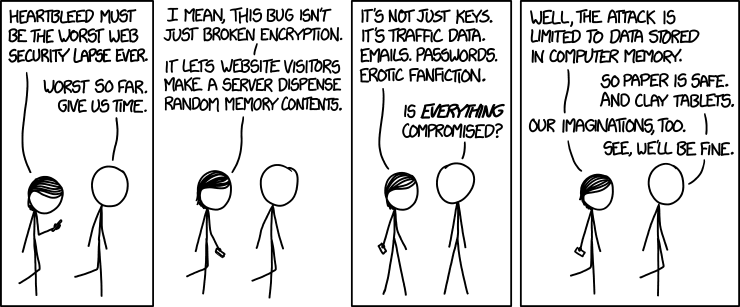
A Little Context on the OpenSSL and GnuTLS Bugs

If I'm getting confused, you probably are too, so for a little historical perspective, here's Steven J. Vaughan-Nichols from last month:

According to some reports you'd think the security sky was falling. Yes, GnuTLS, an open-source "secure" communications library that implements \Secure-Socket Layer (SSL) and Transport Layer Security (TLS), has serious flaws. The good news? Almost no one uses it. OpenSSL has long been everyone's favorite open-source security library of choice.

Red Hat discovered the latest in a long-series of GnuTLS bugs .

Latest? Yes, latest.

You see, GnuTLS has long been regarded as being a poor SSL/TLS security library. A 2008 message on the OpenLDAP mailing list had "GnuTLS considered harmful" as its subject — which summed it up nicely. 

In it, Howard Chu, chief architect for the OpenLDAP, the open-source implementation of the Lightweight Directory Access Protocol (LDAP), wrote, "In short, the code is fundamentally broken; most of its external and internal APIs are incapable of passing binary data without mangling it. The code is completely unsafe for handling binary data, and yet the nature of TLS processing is almost entirely dependent on secure handling of binary data. I strongly recommend that GnuTLS not be used. All of its APIs would need to be overhauled to correct its flaws and it's clear that the developers there are too naive and inexperienced to even understand that it's broken." 

With GnuTLS's most recent and perhaps biggest failure to date, Red Hat found that GnuTLS, when shown a specially rigged kind of bogus SSL certificate, would fail to see that the certificate was a fake.

What we learned this week is that OpenSSL had a vastly worse vulnerability, known as Heartbleed.

So... well, one thing is for sure, if two gaping holes in the security backbone of the open source internet architecture had come out six months after The Cathedral and Bazaar was published, we might be living in a completely different, even more proprietary technological world where, say, your Sun Microsystems stock might be worth something. At this point, the overall role of open source processes is well established, and it is clear that switching to proprietary security software isn't going to protect us from prying eyes. Still, what happened to the open source mantra that "with enough eyeballs, all bugs are shallow?" Well, as Timothy B. Lee put it:

The Heartbleed story highlights just how central to online security the OpenSSL library has become. Thousands of organizations use it to protect the privacy of millions of users. Yet the software is developed by a small, volunteer-driven organization. The project lists just 15 developers as responsible for maintaining the software. As one security expert puts it, the team does "a hard job with essentially no pay."

With so many organizations depending on a small, under-resourced project, mistakes were inevitable. It will cost companies and governments millions of dollars to clean up the mess created by Heartbleed. It would be good if some of those deep-pocketed organizations invested resources in helping to improve the OpenSSL code so it's less likely to happen again.

Unfortunately, there's a huge collective action problem. The risk of any specific company or policymaker being blamed for a security breach is low, so everyone assumes that someone else will do something about it.

Right now, we have a "National Security Agency" dedicated to making the internet insecure. We need the opposite.

Perhaps I Should Write an Op-Ed Demanding an End to Tenure for NY Times Reporters

Andrew O'Hehir:

There were plenty of signs of trouble, too: Blair had been in rehab for cocaine and alcohol abuse, and well before the plagiarism scandal broke, his work was often seen as dubious and full of mistakes. The number of corrections his stories required was three times higher than average; he had received a strongly negative performance review, and one mid-level editor had written a stern memo urging that “we have to stop Jayson from writing for the Times.” In Grant’s film, Howell Raines says the memo never reached his desk, and other editors say that a combination of complacency and bureaucracy kept Blair on the staff, rather than any desire to protect one of the paper’s few African-American reporters.

Wednesday, April 09, 2014

This is Certainly the Way I Look at Living in Elmwood

Daniel Jose Older:

The dominant narrative of the endangered white person barely making it out of the hood alive is, of course, a myth. No one is safer in communities of color than white folks. White privilege provides an invisible force field around them, powered by the historically grounded assurance that the state and media will prosecute any untoward event they may face.

Monday, April 07, 2014

I'd Like to See these Numbers for Rhode Island

Doug Livingston:

Ohio’s public school buses are traveling farther each year to pick up fewer kids, and it’s costing taxpayers more money.

It’s an unintended consequence of school choice. State officials have forced traditional public schools to crisscross their cities to pick up and deliver children to privately run charter schools, often while cutting transportation to their own kids.

The cost for the door-to-door service is significant: About 44 percent more per child, according to an analysis of statewide data.

A child attending a traditional public school and transported on a district bus cost on average $4.30 per day in 2012. The average cost for a charter-school student: $6.18, or $1.88 more per day.

Since then, 22,000 more children have enrolled in charter schools, the state has stopped helping school districts buy new buses and other state transportation assistance has failed to keep pace with costs.

The Most Depressing Thing I've Read in a While

Dan Alexander:

In the two days since he hosted the Republican Jewish Coalition’s meeting with several possible 2016 Republican candidates at his Venetian Resort and Hotel, Adelson personally made $2.1 billion — 21 times the $100 million he reported giving away during the 2012 presidential election.

Friday, April 04, 2014

We've got a School of Sport at Stirling

John Lombardi:

It’s time for the sports performance degree. As anyone who watches the college sports enterprise knows, the profession of sports performance (i.e., being a professional athlete, whether on a golf tour or in professional baseball) is demanding, highly technical, and requires a combination of talent, skill, training, preparation, and dedication.

One only needs to observe the increasingly sophisticated methods and techniques required of baseball and football players, or the careful analysis that goes into learning golf techniques or tennis strategy, to understand that we should provide our students interested in sports performance with similar opportunities to those we provide students seeking a career as a violinist or operatic tenor.

To be sure, academic programs in music, or theater, or dance, with courses in theory and history, as well as performance, have been with us for a long time, and have well-established traditions and curriculums. Sports performance, with its tradition of amateur participation and a long-standing existence outside the academic program as an extracurricular activity, does not have the benefit of an academic tradition.

University of Stirling School of Sport:

Our mission is to be the first choice for anyone with an interest in sport - step onto our campus and you’ll discover it is the perfect setting to study and participate in sport.

The School of Sport is at the heart of the University’s sporting life, with experts in areas such as coaching, psychology, management and science.

There are extensive sports science research and teaching laboratories and one of the best collections of sports facilities in the country including a 50m swimming pool and indoor tennis centre.

Sports scholarships support talented athletes and partnerships with the sports industry ensure students have every opportunity to prepare for careers of their choice.

We've even got an American football team -- the Clansmen!

Seriously though, it makes sense. Sports is a business and an important part of the culture.

More Pointedly on NYS/Pearson

New York state's strategy vis a vis Pearson has been to attack Pearson's core business by paying non-profits to develop open curriculum for the state (and beyond), while turning over to Pearson the decisive point in the process -- the tests -- in fact going out on a limb to do so instead of joining one of the two new multi-state consortiums. If the Common Core fails in New York, even if Pearson's tests are a leading cause, Core Knowledge, Expeditionary Learning, Common Core, Inc., and the other upstart curriculum writers have a lot more to lose than Pearson.

NECAP vs. Common Core at RIFuture

me:

Is one of these clearly intellectually stronger than the other? Why should we think they would be, since the NECAP standards were published in 2006 and closely aligned to Achieve’s American Diploma Project standards, which were a direct precursor to the Common Core standards? There was no breakthrough in our understanding of high school or collegiate English in the intervening three years.

In terms of writing, it depends on if you believe that being “intellectually stronger” requires an almost singular focus on one particular type of formal, logical, academic argument. If you believe that writing for self-expression or aesthetic reasons makes you intellectually weak, you may agree with Dr. Adams and Common Core proponents. On the whole, though, at the high school level Rhode Island’s old and new writing standards are more similar than different.

People don’t trust the Common Core because most of what what we have been told about the standards is obviously not true. Some people are a bit confused about exactly which bits are the lies, but it is no wonder given the context.

Is Pearson Sabotaging the Common Core?

After a quick perusal of Testing Talk (kudos to the remarkably broad range of backers), the little feedback there is about the PARCC and Smarter, Balanced tests is relatively restrained and technology focused, compared to the response to Pearson's New York state test.

e.g., Lucy Caulkins:

Last year, the NYS ELA-a test that was described as bran new and aligned to the CCSS-was bad. We complained, we gave feedback, we worked to improve things-and I think many of us actually believed that the State would try to make a better test this year. But from what we are hearing, this year’s test was worse. The finest principals in the State are all saying that the best thing they could have done was to tell teachers and children to go home. The people I am hearing from are all agreeing the tests will tell nothing of value-that they were not testing anything close to what kids should be able to do in language arts.

I did not see the tests-I am not allowed to do so-therefore I rely on reports, as do all the parents across the State. I’m sympathizing with those parents, wondering what they have heard. What I have heard includes stories about some of the very strongest, most resolute third graders coming up to their teachers with tears welling, saying, “I can’t write anything here. I don’t understand what it is asking.” There are stories of brilliant teachers and principals trying to take the test themselves and finding that too many questions were obscure and confusing, too many had many possible answers. Teachers who are my heroes report their hearts were breaking, they do not know if they can continue to teach. Passages for third grades (on their first standardized test ever) at level X, three-part questions requiring a whole sequence of abstract steps, passages in archaic old English… And always, the kids are being asked to look between paragraphs, back and forth, back and forth, noting structures of paragraphs and intuiting author’s purposes…The work that people describe as being required on the Ela seems to me to be utterly unlike what reading and writing should be like for youngsters.

On the other hand, here's some detailed PARCC observations from RI.

I'm not saying PARCC and Smarter Balanced are fine, I have no idea, really. But as someone who has spent plenty of time talking to teachers and administrators about the problems of garden-variety US standardized testing, the response to the NY Pearson tests was quantitatively and qualitatively off the charts. There was never any reason for Common Core aligned tests to be that different than what preceded them -- and in turn no real reason to think the forthcoming consortium tests would be that much different from the status quo, for better or worse, either.

You have to ask yourself exactly how Pearson screwed up such a pivotal contract so badly. You can see CC as an opportunity to lock up the whole country, but you can also see it as an opportunity for new players to get into the game and grow much more quickly. Either could happen. Pearson has done fine with a fragmented and turbulent state-based system, and the entire Common Core syndicate is so tightly interwoven, interlocking, and justifiably worried about the whole edifice collapsing that it is difficult for anyone to pointedly and publicly critique anyone else.

Consider, for example, the damage to one of College Board's biggest competitors that David Coleman could have done with a few offhand public comments (or some extended formal ones) about the problems with Pearson's NY tests last year. One suspects that the fear of turning the Common Core coalition into a circular firing squad keeps any of them from critiquing the rest, publicly at least.

Thursday, April 03, 2014

The Problems of the Century are This and Climate Change

Charlie Stross:

We can still produce enough food and stuff to feed and house and clothe everybody. We can still run a growth economy. But we don't seem to know how to allocate resources to people for whom there are no jobs. There's a pervasive cultural assumption that people who don't work are shirkers or failures, rather than victims of technological change, and this is an enabler for populist politicians who campaign for support from the frightened (because embattled) working majority by punishing the unlucky, rather than admitting that the core assumption—that we must starve if we can't find work—is simply invalid.

I tend to evaluate the things around me using a number of rules of thumb, one of which is that the success of a social system can be measured by how well it supports those at the bottom of the pile—the poor, the unlucky, the non-neurotypical—rather than by how it pampers its billionaires and aristocrats. By that rule of thumb, western capitalism did really well throughout the middle of the 20th century, especially in the hybrid social democratic form: but it's now failing, increasingly clearly, as the focus of the large capital aggregates at the top (mostly corporate hive entities rather than individuals) becomes wealth concentration rather than wealth production. And a huge part of the reason it's failing is because our social system is set up to provide validation and rewards on the basis of an extrinsic attribute (what people do) which is subject to external pressures and manipulation: and for the winners it creates incentives to perpetuate and extend this system rather than to dismantle it and replace it with something more humane.

Pointedly, the problem is not "preparing kids for jobs that don't exist yet." There will be many jobs that don't exist yet, but there will not be enough of them to employ everyone, full stop.

What then?

Just to be clear, in the medium term, we could get back to more or less full employment with higher government infrastructure and public service spending, but the longer term problem only becomes more clear.

Wednesday, April 02, 2014

Of Course, Then You Need Democrats Who Act Differently Than Republicans

David Atkins:

But there's one other thing that Democrats can do that she doesn't mention: get aggressive about progressive policy at a state level. If Democrats in blue states prove what is possible when Republicans aren't in the way, that would serve as a way to counter cynicism and bring a broader electorate to the polls. It would also emphasize the importance of voting in every race all the way down the ballot.

*cough*

Light blogging lately due mostly to a spring cold I can't shake. This is the problem with relying on multiple bike trips every day to move children and food around, but I'd managed to avoid it until now. I'm fine but just lacking the bursts of mental energy that result in completed blog posts.